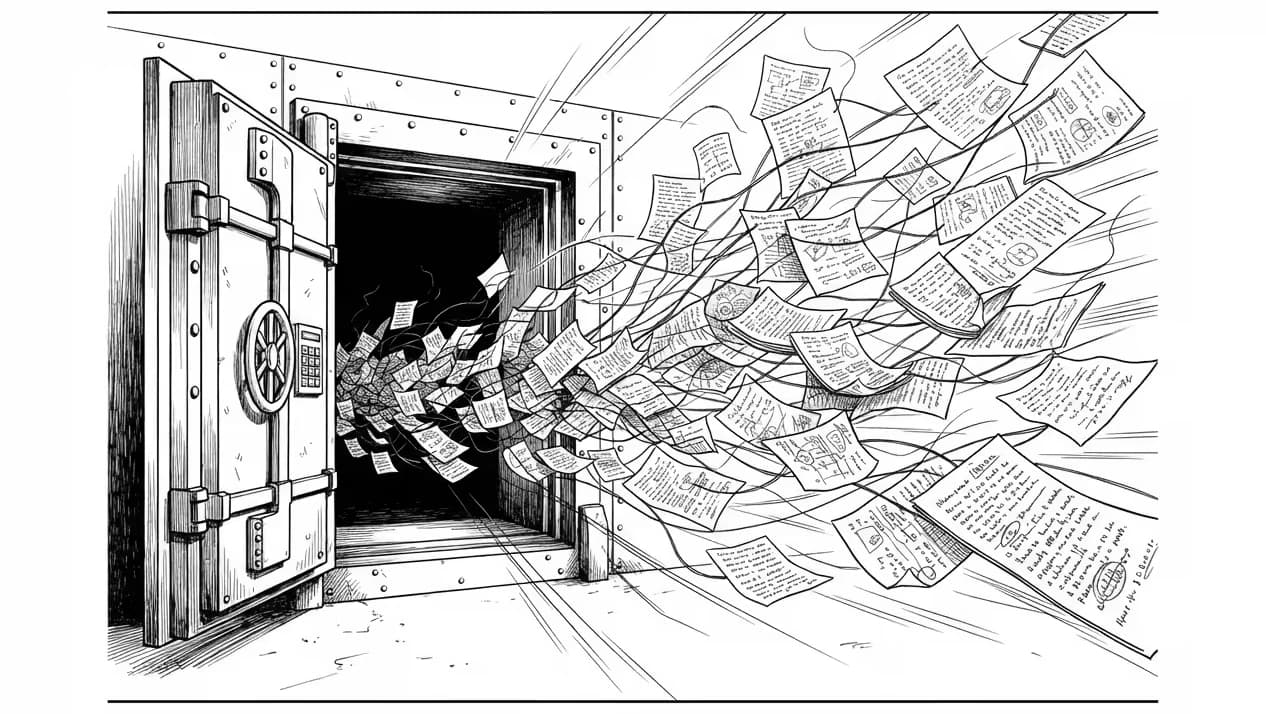
A second brain is not worth what you write down today, but what it accumulates. And it accumulates faster when your own systems write into it.
I keep an Obsidian vault with three-hundred-odd notes. At first it was what it is for almost everyone: a place to leave things so I would not forget them. Now it is something else, and the change did not come from taking better notes.
What I actually use it for
Two jobs, and neither is "taking notes".
It manages my content production. Every video script lives there before it is shot, with its structure, its hook and its tags. It is not a loose draft: it is the channel's unit of work.
It documents my projects. Each project has its folder with the business context, the stack, the modules and — the most valuable part — a results file with the lessons. When I went back to code I had not looked at in three months, I did not have to reconstruct why I had decided what I decided. It was written down.
That second use is the one that has paid off most, and it is the least glamorous: writing down why you did something costs ten minutes and saves you an afternoon six months later.
The day it stopped being an archive
The change came when one of my apps started writing into it.
The system that measures my channel exposes a tool that does something very simple: it finds the video that came out of a given script and returns its metrics as a block ready to paste into that script's note. The link between script and video does not live in any database — it is a convention in the video's own text.
The result is that the script's note carries how it did. I do not have to open the dashboard, find the video, copy numbers and paste them. The loop closes on its own: I write the script, shoot, publish, and the metrics come back to where it all started.
It sounds like convenience. It is more than that: when performance lives next to the text that produced it, you can ask what kind of script works instead of which video worked. And that is a question that does change what you do tomorrow.
Why it appreciates
Here is what made me take it seriously.
A vault is not worth what it holds today. It is worth what it is going to hold. Every note you add does not add up: it multiplies, because the value is in the crossings — this project used that decision, this script worked like that other one, I already made this mistake somewhere else.
And there is a second, more recent reason. The more I work with agents, the more it becomes clear that what decides whether an agent helps me or gets in the way is not the model: it is how much it knows about me. An agent with access to three years of documented decisions, scripts with their results and projects with their reasons is a different tool from one that starts from zero every conversation.
Put another way: every note I write today is context an agent will use two years from now. The vault is not time spent, it is an asset that compounds.
What I changed once I understood that
I write differently since then. Less for tomorrow's me and more for someone — or something — that will read this without having been there.
That means concrete things: putting down the why and not just the what; dating decisions, because circumstances change; and recording mistakes in the same detail as successes, since they tend to be more useful.
And one rule that has served me well: if I have explained something twice, it goes in the vault. The second time you ask yourself the same question is the signal.
What is missing
I still carry things by hand. The vault knows nothing yet about my repositories, or what I have published, or what I am working on this week.
That is the work ahead: getting more systems to write into it. Each one I connect reduces what I have to type and increases what the whole knows. It is the same idea I chase when I put an MCP server on my applications — which I wrote about here — seen from the other end: there I open my apps so they can be queried; here I collect what they return.