The brief
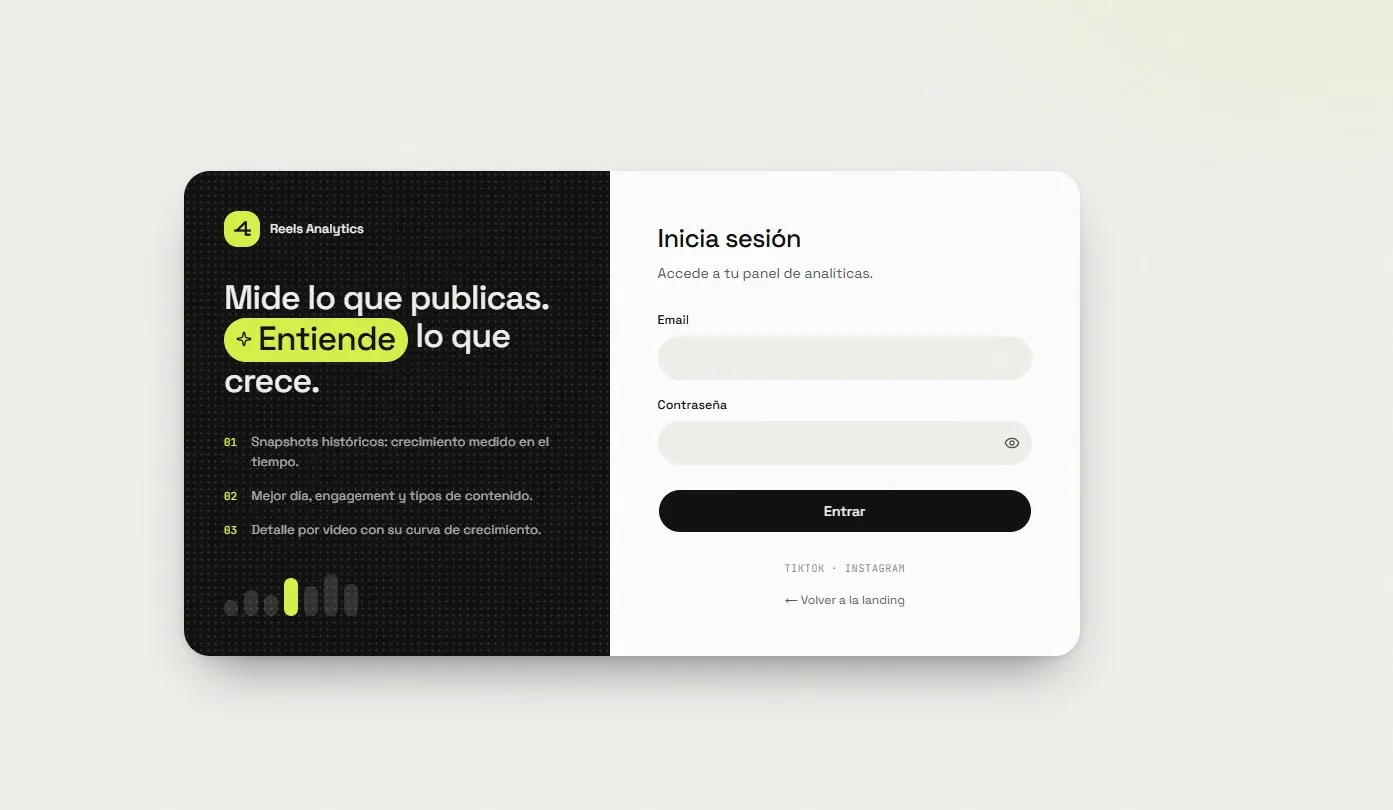
I set it myself. I publish short video on TikTok and Instagram as @axelsine13, and there came a point where I had hundreds of videos out and no way to answer simple questions: what kind of content works, what time is best to post, whether a video really took off or only seemed to.
The problem
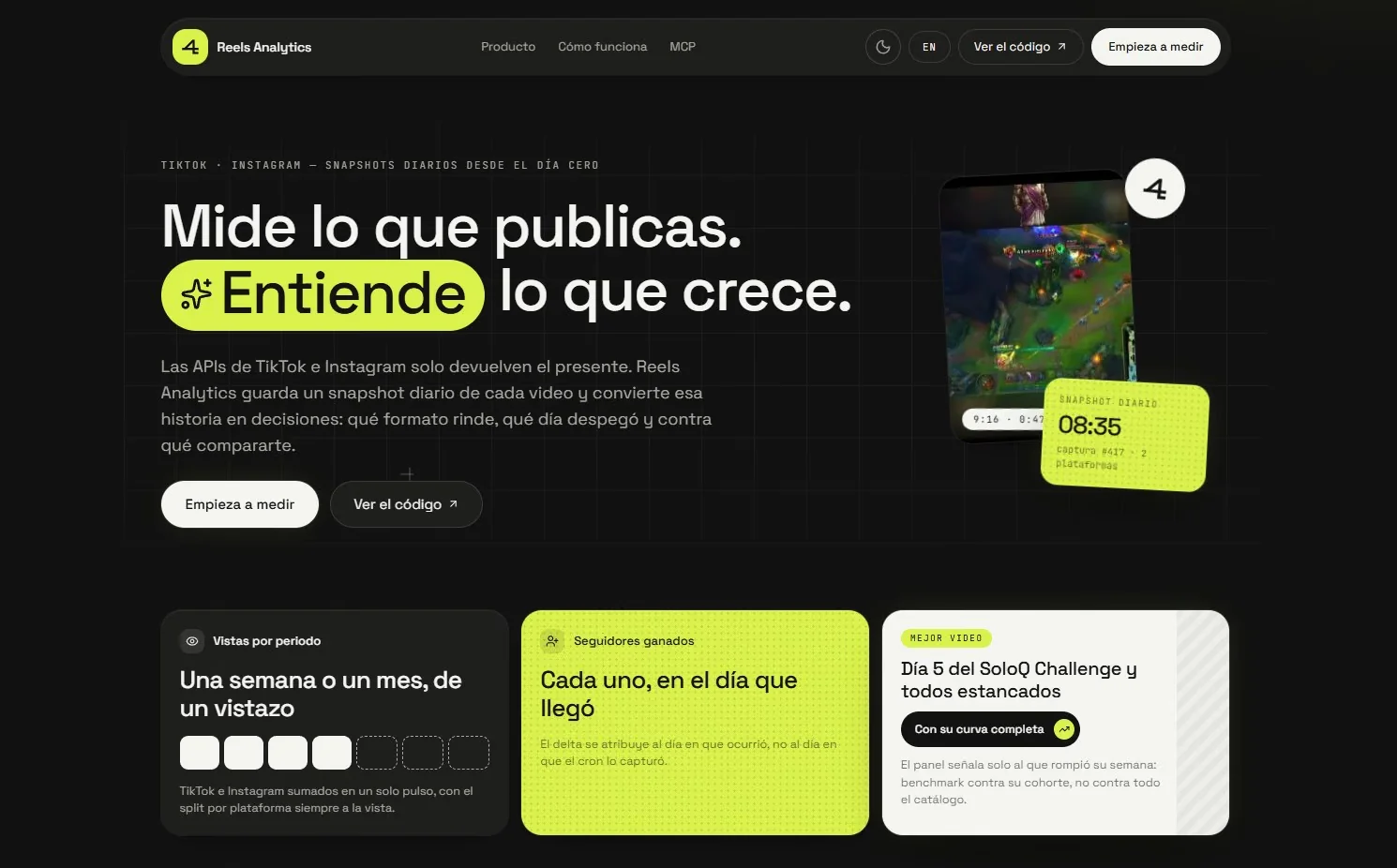
Here is the finding that defines the project: the official APIs return the current state of a metric, never its history. They tell you a video has 40,000 views. They do not tell you whether it got them in six hours or in three weeks — and that difference is exactly the one that matters.
Without history you cannot compare videos of different ages, or spot which one broke out of its cohort, or know what caused a jump in followers.
The decision
Snapshots are the product. A cron job captures the state of every video each day and stores it untouched; growth is computed by comparing snapshots. Storing the raw data and deriving the metrics at read time had a consequence I did not anticipate and that proved invaluable: every time I improve a formula, the improvement applies backwards over the whole history.
The second decision was about honesty. A personal metrics system is only useful if it does not lie to itself, so I designed it to admit what it does not know: when there is not enough data to compare at a given age it returns nothing instead of extrapolating, spikes are cancelled when the cohort cannot discriminate, and follower attribution is labelled as correlation, not cause.
The ports-and-adapters architecture was not a whim: Instagram's rate limits force a rotation between recent videos and a batch of old ones, while TikTok needs nothing of the sort. Each platform solves its own quirks behind the same contract, and adding a new one means implementing that contract, not touching the analytics.
The result
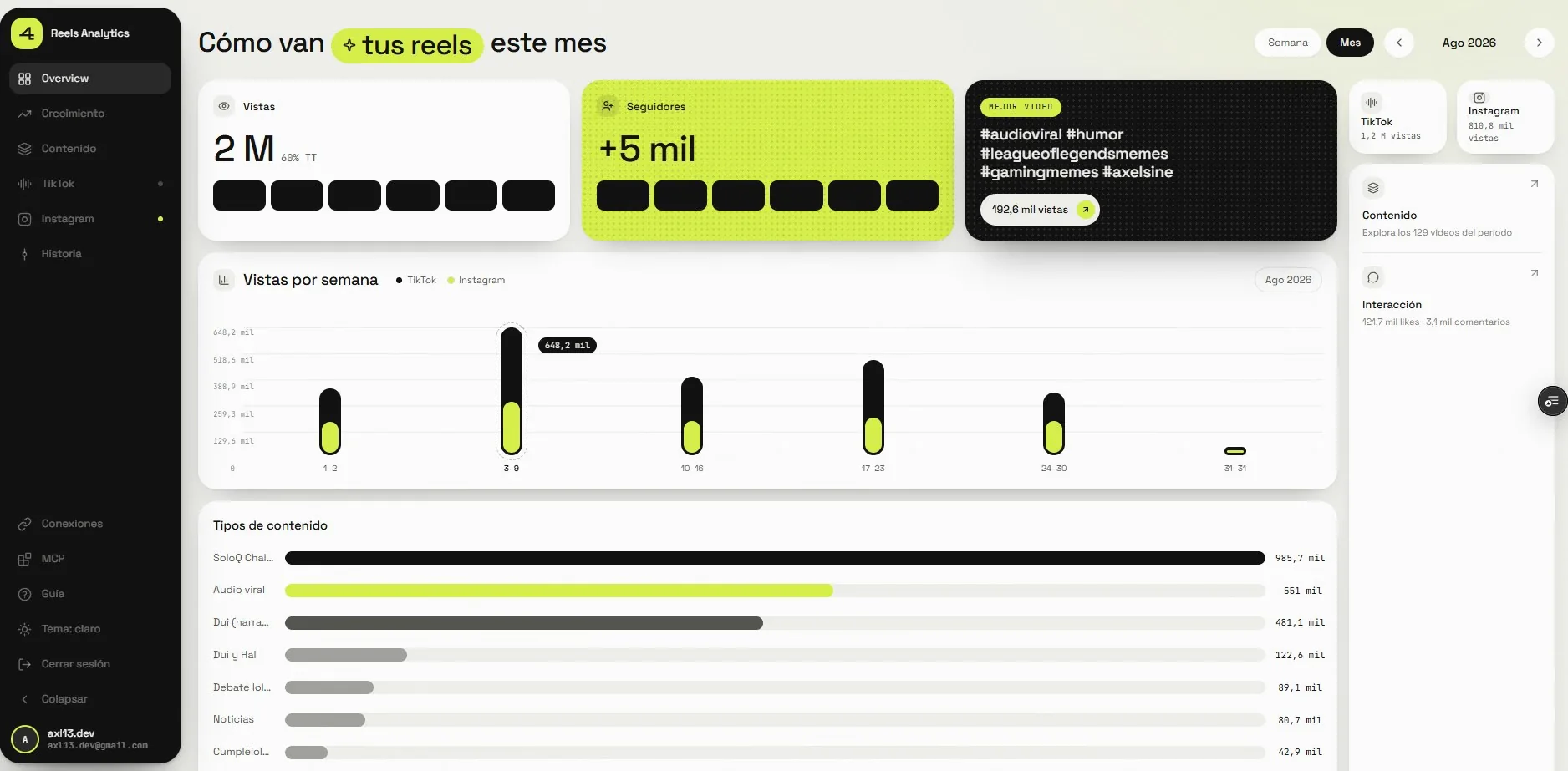
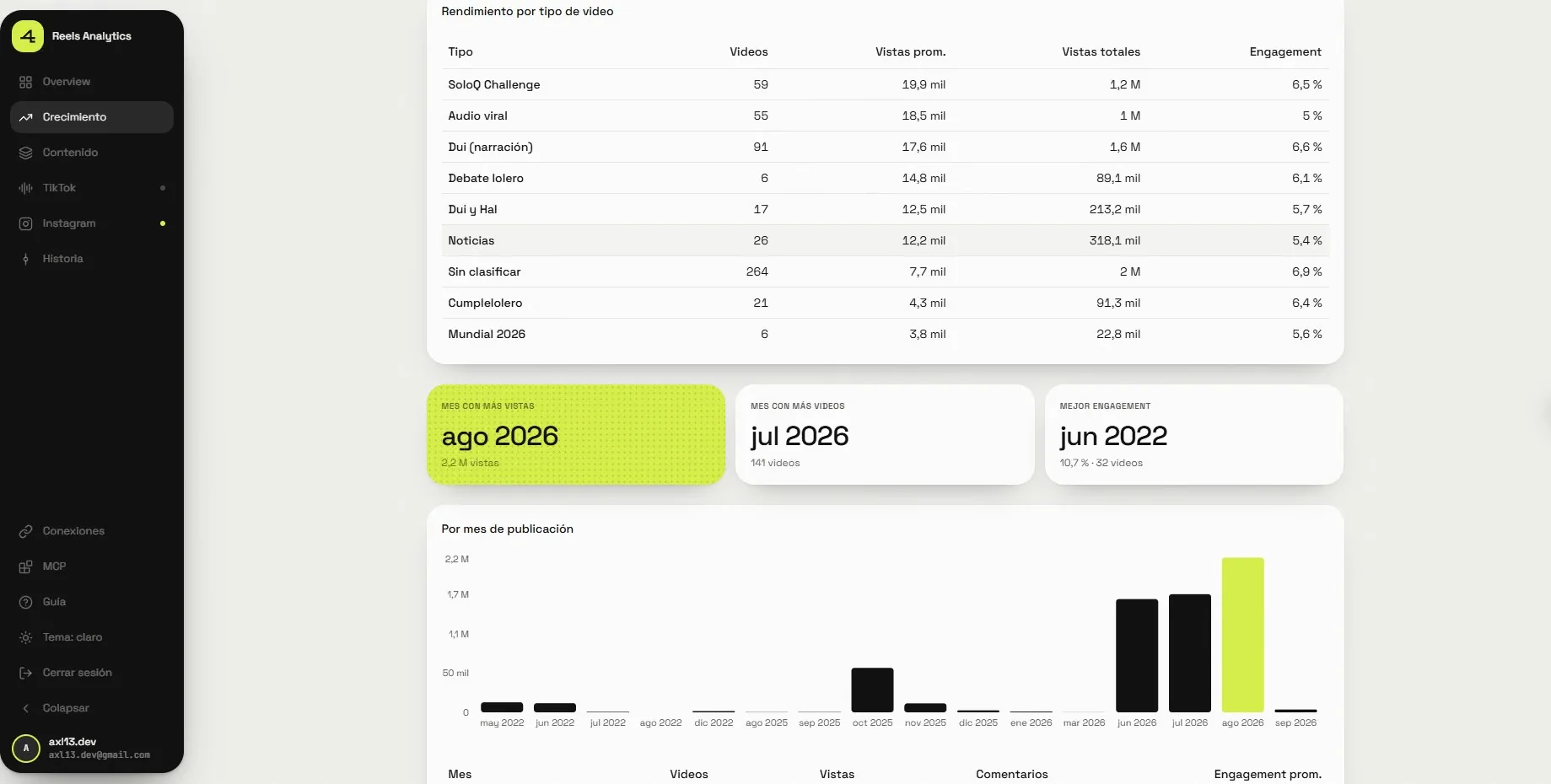
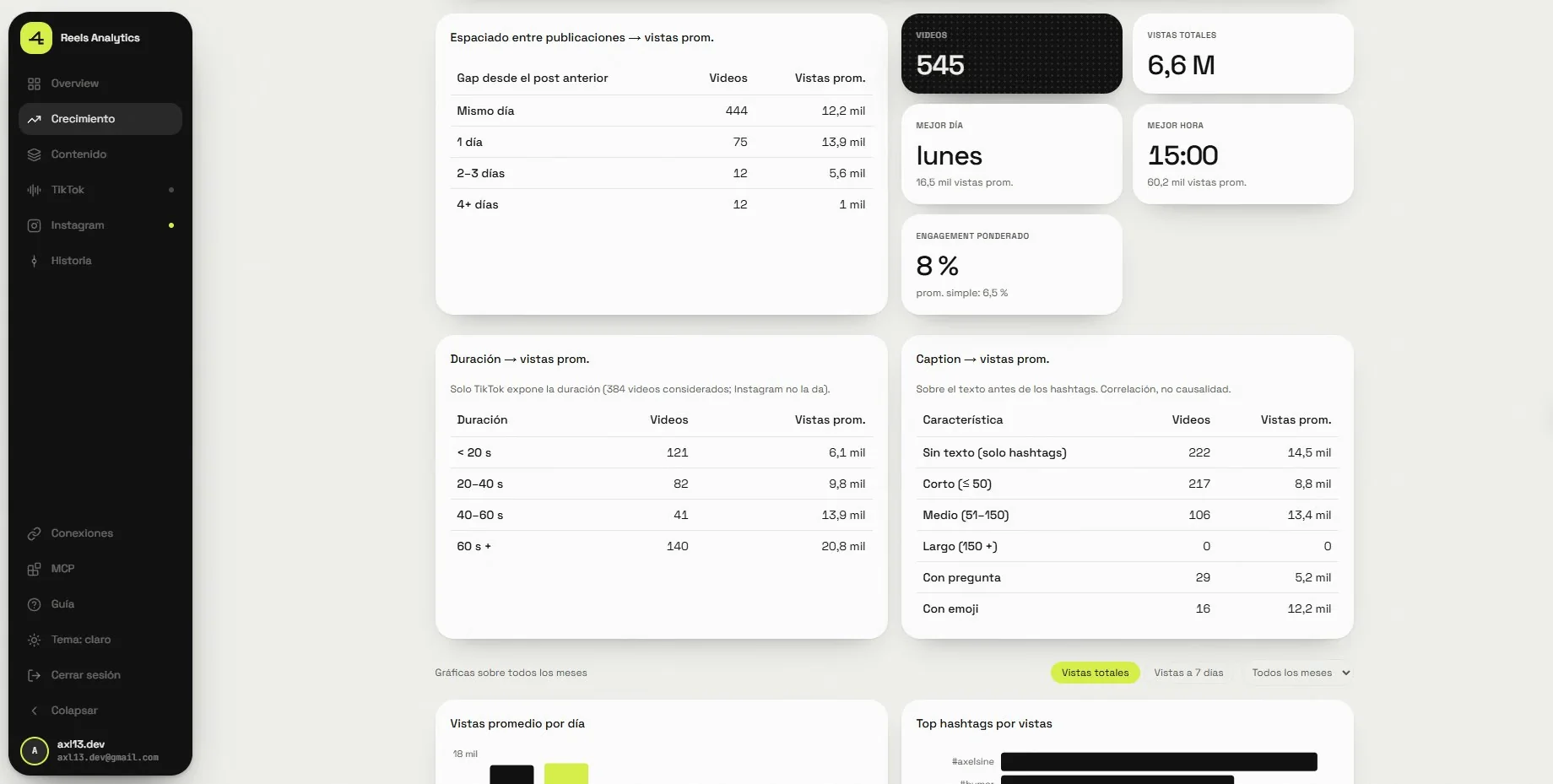
In production with uninterrupted daily ingestion since 4 July 2026, over a catalogue of 524 videos and about 5.97 million accumulated views. From zero to a complete system — ingestion, analytics, dashboard, MCP and a weekly digest — in about 109 commits over one month.
It has already changed real decisions: an experiment with trending audio was settled in its favour with data rather than intuition — 27.8% of that cohort passed 20,000 views, and those days gained 3.25 times more followers than the rest.
Two things I came out of it better at. Implementing full OAuth 2.1 by hand — dynamic client registration, PKCE, refresh rotation, hashed tokens — in a low-risk project of my own, which is the best place to actually read the specs. And discovering that the free tier's limits work as design: two scheduled jobs and sixty seconds of execution forced the whole system to fit exactly there.